Signs Your Home’s Energy Feels Off (And What To Do About It)
There are days when your home feels different, and you can’t quite explain why. The light looks the same. The furniture hasn’t moved. Nothing obvious has changed. Yet something in the atmosphere feels heavier, quieter, almost unsettled.
As sensitive people, we notice shifts long before we understand them. A room can suddenly feel draining. A corner can start to feel uncomfortable. You may find yourself restless in a space that once felt peaceful. These experiences are subtle, but they are not imaginary.
For centuries, homes have been viewed as living spaces in more ways than one. In folklore and traditional witchcraft, houses were believed to absorb emotion, memory, and intention. Just like the body, a home can hold onto what has passed through it. Joy lingers. Grief lingers. Conflict lingers. Energy does not disappear simply because time moves forward.
When a home’s energy feels off, it is often a sign that something needs attention. Stagnant emotion, unresolved tension, illness, stress, or even visitors can shift the atmosphere of a space. The good news is that energy can also be cleansed, reset, and strengthened with intention.
In this post, we will explore how to recognize when your home’s energy feels unbalanced and what you can gently do to restore harmony.
1. Persistent Fatigue When You Are at Home
One of the most common signs that a home’s energy feels off is a strange kind of exhaustion that appears only when you are inside the space. You may be sleeping enough. You may be eating well. You may be doing everything you can to take care of yourself. Yet the moment you step through your door, your body feels heavy.
This kind of fatigue feels different from normal tiredness. It can feel like pressure in the air or a subtle drain on your mood. Your body often recognizes this before your mind does. Our nervous systems are highly sensitive to atmosphere, even when we cannot logically explain what is happening.
As mentioned above, in traditional witchcraft and folk belief, homes were understood to hold memory. Emotional events imprint themselves into spaces. Illness, conflict, grief, and long periods of stress leave a residue. Over time, that residue can create a heaviness that affects everyone living there. Walking into such a room can feel similar to entering a space where someone has just cried. Nothing visible has changed, yet the emotional imprint remains.
2. Avoiding Certain Rooms or Corners
Another clear sign is a growing discomfort in specific areas of your home. A room that once felt neutral may begin to feel uneasy. A hallway might suddenly make you tense. You may find yourself avoiding certain corners without fully understanding why.
Many folklore traditions speak of spatial memory. Certain areas of a home were cleansed more frequently because they were believed to collect stagnant or unsettled energy. Modern energy practitioners sometimes refer to these as dead corners, places where airflow, natural light, and movement are limited. When energy does not circulate, it settles.
Stagnation often feels uncomfortable. Humans are sensitive to an imbalance in space. Even something as simple as poor light and trapped air can shift the emotional tone of a room. When that physical stagnation combines with emotional residue, the effect becomes stronger.
3. Increased Tension or Conflict Inside the Home
If you notice that arguments or irritation happen more often inside the house than outside it, this is worth paying attention to. Environments influence emotional regulation. A space holding unresolved tension can subtly amplify existing stress.
In many magical traditions, the home is considered an energetic container. When that container is not cleared regularly, it can begin to echo past emotions. Minor frustrations feel heavier. Sadness lingers longer. Patience runs thinner.
A healthy home environment supports regulation and calm. When a space consistently increases tension, it is often a sign that it needs attention.
4. Plants Struggling Without a Clear Cause
Plants have long been seen as sensitive indicators of environmental imbalance. They respond to light, water, and temperature, but they also respond to subtle changes in the atmosphere. In many traditions, plants were placed near entrances or in key areas of the home as a form of quiet protection and observation.
If your plants begin to struggle despite proper care, it can sometimes reflect stagnation in the space. In parts of European folklore, herbs placed by doorways were observed closely. If they withered unusually fast, cleansing rituals were performed to reset the energy of the home.
While there are always practical explanations to check first, sudden plant decline can still be a gentle signal that the atmosphere needs renewal.
5. Feeling Unable to Fully Relax
The strongest sign that something feels off is a persistent inability to relax in your own home. You may find yourself alert, restless, or slightly anxious without a clear reason. Even during quiet moments, your body remains on guard.
Our nervous systems respond to environmental cues constantly. If your body does not feel safe enough to settle, there is usually a reason. Safety in a home is not only about physical protection. It is about emotional and energetic steadiness.
When a house feels unsettled, your body reflects that.
Why Home Energy Shifts
Energy within a home shifts for many reasons. Major life changes, breakups, illness, guests, conflict, prolonged stress, and trauma all leave an emotional imprint. Moving into a new space without clearing the previous occupants’ energy can also contribute to discomfort.
Energy in this context is not abstract mysticism. It is emotional residue combined with environmental factors. Sensitive individuals tend to absorb and respond to these shifts more quickly than others.
What To Do When Your Home Feels Off
When you sense imbalance, there is no need to assume something dramatic or dangerous. In most cases, the issue is stagnant emotional residue combined with a lack of movement or clearing. Restoring harmony can be simple and intentional.
1. Begin With Physical Cleaning
Practical cleaning is the foundation of energetic cleansing. Dust, clutter, and stagnant air affect mood and perception. Open the windows, even briefly. Allow fresh air to circulate. Change bed sheets. Vacuum corners. Wipe surfaces. Move small pieces of furniture if possible.
In traditional witchcraft, sweeping was seen as protective work. The broom was a symbol of clearing and boundary setting. As you clean, hold the intention of removing old energy along with the physical dirt. Movement shifts the atmosphere.
2. Use Salt to Absorb Stagnation
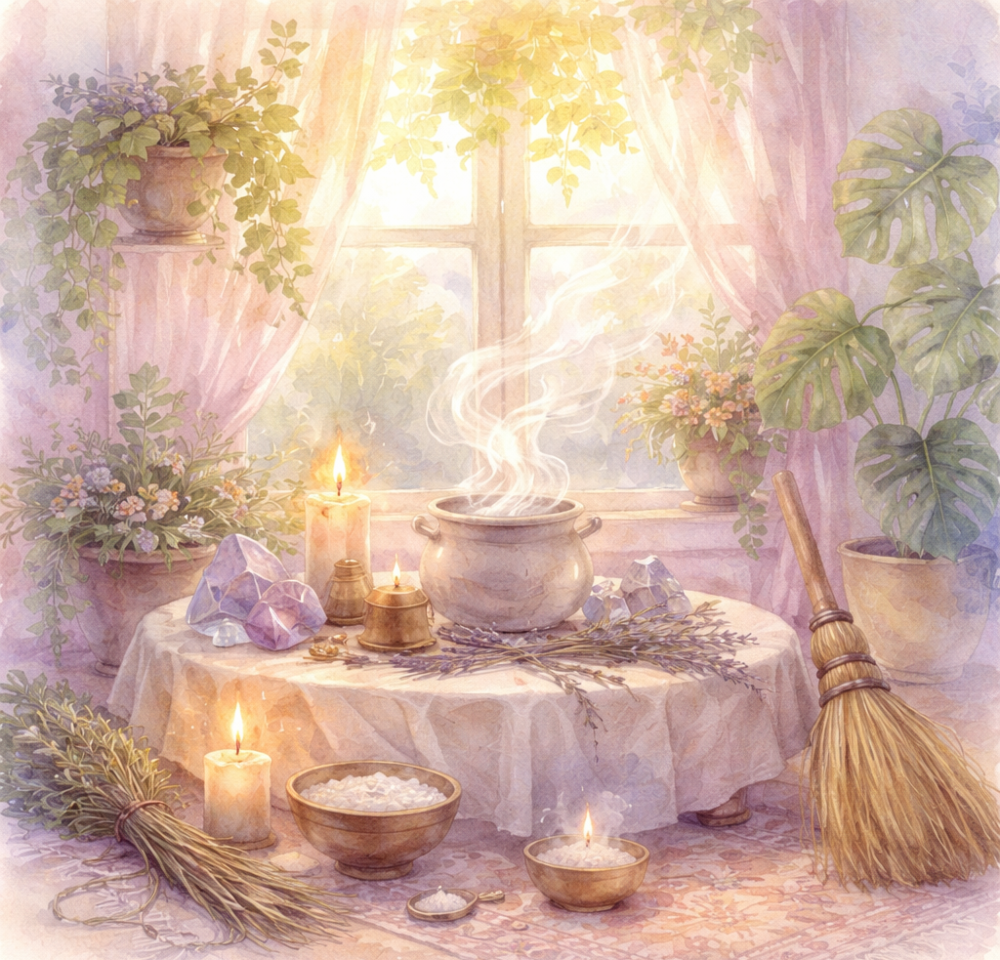
Salt has long been associated with purification and grounding. Place small bowls of sea salt in corners or areas that feel heavy. Leave them for one to three days. Afterwards, discard the salt outside the home. It should not be reused.
This ritual is simple, yet symbolically powerful. Salt represents stability and protection. It draws out excess and restores balance.
3. Smoke Cleansing With Intention
If it feels aligned with your practice, you may use herbs such as mugwort, rosemary, sage, or incense. Move slowly through the home in a clockwise direction. Focus on doorways, mirrors, and corners, as these are traditionally seen as energetic thresholds.
Speaking aloud strengthens intention. Clear, simple words are enough. Affirm that the space is safe, protected, and aligned with peace.
If smoke is not possible, alternative methods such as sound or visualization can be equally effective.
4. Sound as a Clearing Tool
Sound disrupts stagnation. Clapping in corners, ringing a bell, or using a singing bowl introduces vibration into still areas. In folklore, bells were hung on doors to interrupt unwanted energy and invite protection.
Vibration moves what feels stuck. Even intentional music can shift the emotional tone of a room.
5. Protect and Strengthen the Entrance
The entrance of a home has always been considered significant in magical traditions. It is the threshold where energy enters. Lightly anointing the door frame with olive oil and a small amount of salt can symbolize protection and a boundary.
Protective herbs such as rosemary, bay leaf, or lavender may be placed near the entrance. Protection rituals are acts of care. They establish that the home is guarded and intentional.
6. Change the Flow of the Space
Small adjustments can alter the atmosphere of a room. Shifting the direction of a bed, moving a table, or reorganizing furniture changes how energy circulates. Many spatial traditions emphasize the importance of flow, including Feng Shui principles.
Stagnation weakens when movement is introduced.
7. Call Your Energy Back
At times, the heaviness in a home reflects personal depletion. Sit quietly and take a few deep breaths. Visualize your energy returning from places where it has been scattered through stress, conflict, or emotional strain.
You may say quietly, “I call my energy back.” Imagine threads of light reconnecting to you. This practice restores personal boundaries and strengthens your presence within your own space.
Final Thoughts
A home should support rest, safety, and restoration. When something feels unsettled, it deserves gentle attention. Sensitivity to atmosphere is awareness, not imagination.
Caring for the energy of your home is an extension of caring for yourself. Regular cleansing, movement, and protection create a stable foundation for emotional and spiritual well-being.
Your space reflects you. When you tend to it with intention, it begins to feel like home again.